
Join Us As We Celebrate 30 Years Online!*
The Battle Of Leyte Gulf: 2 MP4 Downloads Or 2 DVD Set
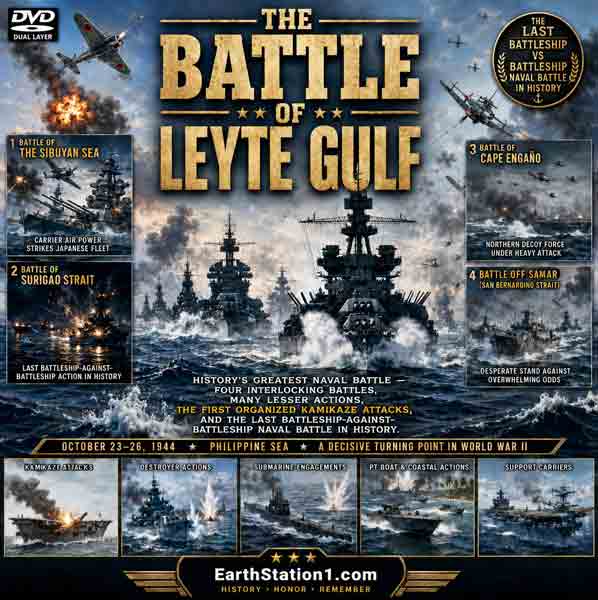
History's Greatest Naval Battle, Fought Between The U.S. And Imperial Japanese Navies During World War II - So Large It Encompassed Four Battles - The Battle Of The Sibuyan Sea, The Battle Of Surigao Strait, The Battle of Cape Engano And The Battle Off Samar (Also Known As The Battle Of San Bernardino Strait), As Well As Many Lesser Actions - And The First Battle To Employ Organized Kamikaze Attacks, And The Last Naval Battle Between Battleships In History, As Seen Through The Lens Of Five VHS-Era Classic Documentaries From The Golden Age Of Cable Television, And Heard Through The Airwaves Of His "I Have Returned: Broadcast! Another Restored Collection Of VHS-Era Classics From The Golden Age Of Cable Television, Presented In Our Highest DVD Quality MPEG Video Format Of 9.1 MBPS In A 2 Volume Video Download MP4 Set Or A 2 Disc Archival Quality All Regions Format DVD Set! (2 Hours 21 Minutes Total.) #BattleOfLeyteGulf #BattleOfTheSibuyanSea #BattleOfSurigaoStrait #BattleOfCapeEngano #BattleOffSamar #BattleOfSanBernardinoStrait #BattleOfLeyte #USThirdFleet #USSeventhFleet #IJN #ImperianJapaneseNavy #AircraftCarriers #Carriers #NavalHistory #MilitaryNavalHistory #Kamikazes #PacificWar #AsiaPacificWar #AsiaticPacificTheater #WorldWarII #WWII #WW2 #WorldWarTwo #WorldWar2 #SecondWorldWar #MP4 #VideoDownload #DVD
* July 22, 2026: Updated And Expanded: Updated With Everything Except This Title's Original OUR CENTURY: SHOWDOWN AT LEYTE GULF Documentary, And Expanded From A Single Volume To A Two Volume Set MP4 Video Set, And An Upgraded And Expanded DVD Version From A Standard Format Disc To A 2 Disc Archival Quality Dual Layer Format Disc Set!
Contents:
VOLUME ONE:
Our Century: Showdown At Leyte Gulf -- An episode of the A&E television documentary showcase hosted by Edward Herrmann (Color, 1993, 48 Minutes).
MacArthur 44-10-20 ''A-Day'' - ''I Have Returned'' Leyte Gulf Landing (22 Seconds) -- An excerpt of General Douglas MacArthur’s radio broadcast upon his return to the Philippines along with U.S. and Filipino forces landing at Red Beach, Palo, Leyte. “A Day” was the codename he gave to the operation to distinguish it from the “D-Day” landings in Normandy, France on June 6, 1944. From Douglas MacArthur Radio Broadcasts & Speeches MP3 Set.
GI Diary: Epi. #17 - 19441020 Leyte: Return To The Philippines -- An episode of "America's World War II Combat Diary Preserved In Stunning Color Film And Narrated By Lloyd Bridges" (Color, 1978, 23 Minutes).
VOLUME TWO:
Victory At Sea: Epi. #19: The Battle For Leyte Gulf -- An episode of the landmark television documentary series. Rousing music by Richard Rodgers and Robert Russell Bennett, and narrated by Leonard Graves (Black/White, 53-03-15, 27 Minutes).
Carriers: Kamikaze -- A careful and concise history of the emergence and employment of Kamikaze warfare from its emergence during the Battle Of Leyte Gulf up to the very end of the Pacific War. From Carriers: Aircraft Carrier History TV Series. (Color, 1992, 23 Minutes).
Biography (CBS): Admiral William Halsey -- The mother of all TV biography documentary series gives its standard-setting treatment to the great American fleet admiral of the United States Navy in the Pacific during World War II who led US Naval forces during The Battle Of Leyte Gulf. From Admiral William Halsey Documentaries & Biographies (Black/White, 1962, 23 Minutes).
The Battle Of Leyte Gulf (October 23-26, 1944), fought in October 1944 near the Philippine Islands, was the largest naval battle in history and a decisive defeat for the Japanese Navy during World War II. The battle began after Allied forces under General Douglas MacArthur invaded the island of Leyte to begin liberating the Philippines. In response, Japan launched a complex plan involving multiple fleets intended to lure away the main American carrier forces and attack the vulnerable invasion fleet. Over several days, major engagements occurred across a vast area, including the Sibuyan Sea, Surigao Strait, Cape Engaño, and the Battle off Samar. Japanese forces suffered catastrophic losses, including battleships, aircraft carriers, cruisers, and destroyers, while American naval and air forces demonstrated overwhelming superiority in carrier aviation and coordinated fleet operations. The battle also marked the first organized use of Japanese kamikaze suicide attacks. After Leyte Gulf, the Imperial Japanese Navy was largely destroyed as an effective fighting force, allowing the Allies to continue their advance toward Japan with greatly reduced naval opposition.
New Permanent Price Reductions!
Launching Our Summer "I Never Knew That Existed!" Days!
A New Commitment From EarthStation1.com!
Issued Sunday, June 28, 2026
For thirty years, EarthStation1.com has existed for one purpose: to preserve, curate, and share the history of our world through television, radio, film, and documentary media. During that time, the world has changed dramatically. The cost of nearly everything has risen, and for many people, simply making ends meet has become more difficult than ever. We believe that learning, discovery, and the enjoyment of history should never become luxuries reserved only for those who can afford them.
Beginning today, EarthStation1.com is introducing a new long-term pricing philosophy. Rather than asking, "What is the highest price people will pay?" we are asking a different question: "What is the fairest price that allows the greatest number of people to own, enjoy, and preserve these remarkable programs?" We want students, teachers, veterans, researchers, families, collectors, and lifelong learners everywhere to have access to the extraordinary stories that have shaped our world—without price becoming an unnecessary barrier.
This is more than a sale. It is a commitment to the future of EarthStation1.com and to the people we have proudly served since 1996. Our hope is simple: that by making our catalog more affordable than ever before, we can place more history into more homes, encourage greater understanding of our shared past, and ensure that these important films, broadcasts, and recordings continue to educate and inspire for generations to come. We invite you to explore our collection, rediscover old favorites, uncover new treasures, and join us as we begin this exciting new chapter together.
— Sam Fellowes
Executive Director of Customer Experience
EarthStation1.com

***** BAAAAHH-DAH-DAH-DAAAAAAHHHH!!! *****
HERALD: Hear ye! Hear ye! Let it be proclaimed throughout the Known and Unknown Universe!
By decree of the Curator of EarthStation1.com™, and with the enthusiastic concurrence of the Executive Director of Customer Experience...
Henceforth shall the proclamation read:
15% (Or More!) Daily Specials
...and there was much rejoicing among historians, documentary enthusiasts, collectors, lovers of old television and radio, seekers of the obscure, and all who delight in discovering the treasures of the past without having to mortgage the present.
The fanfare crescendos... banners unfurl... somewhere, Yul Brynner nods approvingly... and Cecil B. DeMille quietly murmurs, "Print it."

Copyright © 1996-2026 J. C. Kaelin, Jr., Proprietor, EarthStation1.com and MediaOutlet.com.
[Our motto and graphic by Sam Fellowes (2026).]