
Join Us As We Celebrate 30 Years Online!*
Great Sea Battles Of WWII: The War Files MP4 Video Download Or DVD
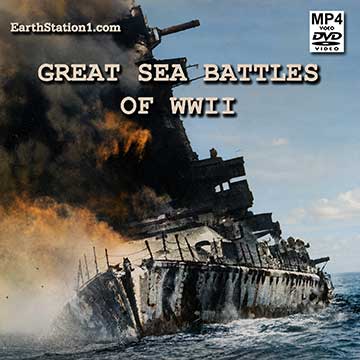
A Comprehensive Overview Of The Great Naval Battles Of The Second World War, Presented In The Highest DVD Quality MPG Video Format Of 9.1 MBPS As An MP4 Video Download Or Archival Quality All Regions Format DVD! (Black/White, 1991, 58 Minutes.) #GreatSeaBattlesOfWWII #WarFiles #USNavyInWorldWarII #UnitedStatesNavyInWWII #USNavyInWWarII #ImperialJapaneseNavy #IJN #RoyalNavy #RN #Kriegsmarine #NavalHistoryOfWWII #BattleOfTheAtlantic #PacificWar #PacificOceanTheatreOfWWII #PacificOceanTheaterOfWWII #SouthWestPacificTheatreOfWWII #SouthWestPacificTheaterOfWWII #AsiaPacificWar #AsiaticPacificTheater #NavalHistoryOfWorldWarII #NavalHistoryOfWWII #WorldWarII #WWII #WW2 #WorldWarTwo #WorldWar2 #SecondWorldWar #NavalHistory #NavalWarfare #Navies #NavalForces #MaritimeForces #BlueWaterNavies #SecondEuropeanWar #EuropeanCivilWar #MP4 #VideoDownload #DVD
The Naval Battles Of World War II transformed warfare on the seas and determined the fate of entire nations across both the Atlantic and Pacific theaters. In the Atlantic, the long Battle of the Atlantic saw German U-boats attempt to strangle Britain’s supply lines, while Allied convoys, radar, sonar, and codebreaking gradually turned the tide. In the Pacific, aircraft carriers replaced battleships as the dominant naval weapon after the Japanese attack on Pearl Harbor in 1941 drew the United States into the war. Major engagements such as the Battle of Coral Sea, the Battle of Midway, and the naval battles around Guadalcanal shattered Japanese offensive power and demonstrated the decisive role of naval aviation. Later battles, including Leyte Gulf — the largest naval battle in history — destroyed much of the remaining Japanese fleet and opened the path toward Japan itself. These sea battles not only shaped military strategy for the modern age but also determined the movement of armies, the survival of nations, and ultimately the outcome of the war.
The German U-boat Campaign in The Battle Of The Atlantic was one of the longest and most critical struggles of World War II. Beginning in 1939, German submarines sought to cut Britain off from food, fuel, troops, and supplies by sinking merchant ships crossing the Atlantic Ocean. Using “wolf pack” tactics, groups of U-boats coordinated nighttime attacks on Allied convoys, often causing devastating losses during the early years of the war. For a time, the submarines brought Britain dangerously close to economic collapse. However, the Allies gradually gained the advantage through improved convoy organization, long-range aircraft patrols, radar, sonar, escort carriers, and the breaking of German Enigma codes by Allied cryptanalysts. By 1943, U-boat losses had become unsustainable, and the balance shifted decisively in favor of the Allies. Although German submarines continued fighting until the war’s end, the failure of the U-boat campaign ensured that Britain remained supplied and able to serve as the staging ground for the eventual liberation of Europe.
The German pocket battleship Admiral Graf Spee was one of Nazi Germany’s most famous surface raiders during the opening months of World War II. Commissioned in 1936, the ship was heavily armed with six 11-inch guns yet fast enough to outrun many enemy battleships, embodying Germany’s strategy of commerce raiding against Allied shipping. At the outbreak of war in 1939, the Graf Spee entered the South Atlantic and Indian Oceans, sinking multiple British merchant vessels while generally treating captured crews according to naval tradition. Its career came to a dramatic end at the Battle of the River Plate in December 1939, when it fought three British cruisers off the coast of South America. Although the Graf Spee damaged the British ships, it was itself damaged and sought refuge in Montevideo, Uruguay. Misled by British intelligence operations into believing overwhelming enemy forces were waiting outside the harbor, Captain Hans Langsdorff chose to scuttle the ship rather than see it destroyed or captured. The burning wreck became an early symbolic Allied victory, while Langsdorff himself later took his own life in Buenos Aires
The Battles Of Narvik were a series of fierce naval and ground engagements fought in northern Norway during the spring of 1940, centering on the strategically important port of Narvik, through which Swedish iron ore was shipped to Germany. Following Germany’s surprise invasion of Norway in April 1940, German destroyers transported mountain troops to seize the town, but the Kriegsmarine vessels soon found themselves trapped in nearby fjords by the British Royal Navy. Two major naval battles followed, in which British destroyers and the battleship HMS Warspite systematically destroyed much of the German destroyer force in the area. Meanwhile, Allied British, French, Polish, and Norwegian troops launched counterattacks in the surrounding mountains and briefly recaptured Narvik, marking one of the first Allied land victories of the war. However, the worsening situation in France after the German offensive in Western Europe forced the Allies to withdraw from Norway in June 1940, allowing Germany to retain control of the region despite its severe naval losses.
The British Attack On The French Fleet At Mers-el-Kébir in North Africa in July 1940 was one of the most tragic and controversial naval actions of World War II. After France surrendered to Germany, Britain feared that powerful French warships might fall under Nazi control and threaten British naval supremacy. Although the new Vichy French government insisted the fleet would remain neutral, Prime Minister Winston Churchill ordered the Royal Navy to present French commanders with an ultimatum: join the British, sail to neutral ports, or scuttle their ships. When negotiations failed at the Algerian port of Mers-el-Kébir, British warships opened fire on their former allies. Several French battleships were sunk or heavily damaged, and nearly 1,300 French sailors were killed. The attack shocked the world and deeply strained relations between Britain and Vichy France, but Churchill believed the action demonstrated Britain’s determination to continue the war against Germany regardless of the cost.
The Battle Of The Mediterranean was a prolonged naval struggle fought between the Allied and Axis powers from 1940 to 1945 for control of the Mediterranean Sea, a vital route linking Europe, North Africa, and the Middle East. The conflict involved major naval engagements, submarine warfare, air attacks, and convoy battles as Britain sought to supply Malta and maintain access to Egypt and the Suez Canal while Italy and Germany attempted to cut these lifelines and support Axis forces in North Africa. Key actions included the British carrier strike on the Italian fleet at Taranto, the Battle of Cape Matapan, the brutal convoy battles to Malta, and constant attacks by submarines and aircraft on both sides. Control of the Mediterranean shifted gradually toward the Allies as Axis naval and air power weakened, especially after Allied victories in North Africa and the invasion of Italy. By the later stages of the war, Allied dominance in the Mediterranean helped secure southern Europe and contributed significantly to the eventual defeat of the Axis powers.
The British Attack On Taranto was a daring carrier-based air strike carried out by the Royal Navy against the Italian fleet at the harbor of Taranto in southern Italy on the night of November 11–12, 1940. Launched from the aircraft carrier HMS Illustrious, slow but highly effective Fairey Swordfish torpedo bombers attacked Italian battleships anchored in the harbor, crippling several major vessels with torpedoes and bombs while suffering only minimal losses themselves. The raid demonstrated that aircraft launched from carriers could successfully strike heavily defended naval bases, even in shallow waters previously thought unsuitable for torpedo attacks. Taranto significantly weakened Italian naval strength in the Mediterranean and had a profound influence on naval strategy worldwide; Japanese planners closely studied the operation while preparing for their later attack on Pearl Harbor. The success of the strike marked a turning point in naval warfare, showing that air power had begun to eclipse the traditional dominance of the battleship.
The Battle Of The Atlantic was the longest continuous military campaign of World War II, lasting from 1939 until Germany’s defeat in 1945. It was a struggle between Allied naval and air forces and German U-boats, surface raiders, and aircraft over control of the Atlantic Ocean’s vital shipping lanes. Germany sought to cut Britain off from food, fuel, weapons, and reinforcements by sinking merchant ships faster than they could be replaced, while the Allies fought to keep convoys moving safely across the ocean. In the early years of the war, German submarines inflicted devastating losses through coordinated “wolf pack” attacks, bringing Britain close to economic collapse. Over time, however, the Allies gained the advantage through improved convoy tactics, radar, sonar, long-range patrol aircraft, escort carriers, and intelligence breakthroughs such as the cracking of German Enigma codes. By mid-1943 the tide had decisively turned against the U-boats, and the Allies gradually secured the Atlantic sea lanes, ensuring the flow of men and supplies necessary for the liberation of Europe and the eventual defeat of Nazi Germany.
The Sinking Of The German Battleship Bismarck in May 1941 was one of the most dramatic naval episodes of World War II. Shortly after entering the Atlantic on a mission to attack Allied shipping, the Bismarck encountered British warships in the Denmark Strait and sank the battlecruiser HMS Hood, pride of the Royal Navy, in a catastrophic explosion that shocked Britain. Determined to destroy the German battleship, the Royal Navy launched a massive pursuit involving battleships, cruisers, destroyers, and aircraft carriers across the North Atlantic. The turning point came when torpedo planes from the carrier HMS Ark Royal damaged the Bismarck’s rudder, leaving the ship unable to steer effectively. Surrounded and outgunned, the crippled battleship was attacked relentlessly by British forces on May 27, 1941, and eventually sank after heavy shelling and torpedo strikes, with only a small fraction of her crew surviving. The destruction of the Bismarck was a major propaganda and strategic victory for Britain and demonstrated the growing importance of naval air power in modern warfare.
The Attack On Pearl Harbor was a surprise military strike launched by the Japanese Empire against the United States Pacific Fleet at Pearl Harbor, Hawaii, on the morning of December 7, 1941. Seeking to cripple American naval power and prevent interference with Japanese expansion in Asia and the Pacific, Japan sent carrier-based aircraft in two attack waves against battleships, airfields, and military installations. The assault sank or damaged numerous American warships, including several battleships, and destroyed hundreds of aircraft, while more than 2,400 Americans were killed. Although the attack achieved tactical surprise, it failed to destroy key American assets such as aircraft carriers, submarine facilities, and fuel storage depots, which were absent or survived the raid. The following day, the United States declared war on Japan, bringing America fully into World War II and transforming the conflict into a truly global war. Pearl Harbor remains one of the most significant and symbolic events in modern American history.
The Battle Of The Coral Sea, fought in May 1942 between Allied and Japanese naval forces, was a pivotal early engagement in the Pacific War and the first naval battle in history in which opposing fleets never directly sighted or fired upon one another. Instead, the battle was fought entirely by carrier-based aircraft launched from ships far beyond visual range. Japan sought to capture Port Moresby in New Guinea, which would have threatened Australia and strengthened Japanese control of the South Pacific. American and Australian forces, led by the aircraft carriers USS Lexington and USS Yorktown, moved to intercept the invasion force. During the battle, both sides suffered significant losses, including the sinking of the Lexington and the Japanese light carrier Shoho, while the Japanese fleet carrier Shokaku was heavily damaged. Although tactically indecisive, the battle was a major strategic Allied success because it halted the Japanese advance toward Port Moresby and weakened Japanese carrier strength just before the decisive Battle of Midway the following month.
The Battle Of Midway, fought in June 1942, was one of the most decisive naval battles of World War II and a turning point in the Pacific War. Seeking to destroy the remaining American aircraft carriers after Pearl Harbor, Japan launched a major attack against Midway Atoll, believing it would lure the U.S. fleet into a trap. However, American cryptanalysts had broken key elements of the Japanese naval code, allowing the United States Navy to prepare an ambush. During the battle, carrier-based American aircraft from the USS Enterprise, USS Hornet, and USS Yorktown attacked the Japanese fleet and, in a matter of minutes, fatally damaged four frontline Japanese aircraft carriers — Akagi, Kaga, Soryu, and Hiryu — along with many experienced pilots and aircraft. Although the Americans lost the Yorktown, Japan’s losses were irreplaceable and shattered its offensive naval power. Midway halted Japanese expansion in the Pacific and shifted the strategic initiative to the United States, marking the beginning of a long Allied advance toward Japan.
The Naval Battle Of Guadalcanal, fought in November 1942 around the Solomon Islands, was one of the fiercest and most decisive naval struggles of the Pacific War. As Japanese and Allied forces fought for control of Guadalcanal and its vital airfield, both sides launched repeated naval operations to reinforce their troops and destroy enemy positions. Over several days and nights, battleships, cruisers, destroyers, submarines, and aircraft clashed in chaotic close-range combat often fought in darkness at point-blank range. The fighting was exceptionally brutal, with heavy losses on both sides, including the sinking of numerous warships and the deaths of many experienced sailors. Despite suffering severe damage, the United States Navy prevented Japan from bombarding Henderson Field and from delivering major reinforcements to the island. The battle marked a critical strategic turning point because it crippled Japan’s ability to continue large-scale offensive operations in the South Pacific and helped secure Allied control of Guadalcanal, beginning the long Japanese retreat across the Pacific.
The Naval Operations Supporting The Allied Invasion Of North Africa, known as Operation Torch, were a massive and complex undertaking carried out in November 1942. Allied fleets from the United States and Britain transported and protected tens of thousands of troops landing at key locations in Morocco and Algeria, including Casablanca, Oran, and Algiers. The operation required large-scale convoy coordination across the Atlantic and Mediterranean while guarding against attacks from German U-boats, aircraft, and Vichy French naval forces. During the landings, Allied warships exchanged fire with French coastal batteries and naval vessels, particularly near Casablanca where American forces fought the incomplete French battleship Jean Bart and other defending ships. Although resistance varied, the naval component successfully secured the invasion routes and enabled the rapid establishment of Allied forces in North Africa. Operation Torch marked the first major American offensive operation in the European theater and laid the groundwork for the eventual Allied campaign against Axis forces in North Africa and later invasions of Italy and southern Europe.
The Naval Operations Of D-Day, conducted on June 6, 1944, formed one of the largest amphibious assaults in history and were essential to the success of the Allied invasion of Nazi-occupied France. Under the codename Operation Neptune, thousands of warships, landing craft, transports, minesweepers, and support vessels from Britain, the United States, Canada, and other Allied nations crossed the English Channel to deliver troops onto the beaches of Normandy. Battleships, cruisers, and destroyers bombarded German coastal defenses before and during the landings, while minesweepers cleared safe routes through heavily mined waters. The navy also transported tanks, supplies, and reinforcements, protected the invasion fleet from German naval and submarine attacks, and helped coordinate the enormous logistical effort required to sustain the invasion. Despite rough seas, strong German resistance, and heavy casualties—especially at Omaha Beach—the naval operation successfully established a secure foothold in France, opening the long-awaited Western Front and beginning the liberation of Western Europe from Nazi control.
The Battle Of Leyte Gulf, fought in October 1944 near the Philippine Islands, was the largest naval battle in history and a decisive defeat for the Japanese Navy during World War II. The battle was so large it encompassed four individual battles - The Battle Of The Sibuyan Sea, The Battle Of Surigao Strait, The Battle of Cape Engano And The Battle Off Samar (also known as The Battle Of San Bernardino Strait), as well as many lesser actions. The battle began after Allied forces under General Douglas MacArthur invaded the island of Leyte to begin liberating the Philippines. In response, Japan launched a complex plan involving multiple fleets intended to lure away the main American carrier forces and attack the vulnerable invasion fleet. Over several days, major engagements occurred across a vast area. Japanese forces suffered catastrophic losses, including battleships, aircraft carriers, cruisers, and destroyers, while American naval and air forces demonstrated overwhelming superiority in carrier aviation and coordinated fleet operations. The battle also marked the first organized use of Japanese kamikaze suicide attacks. After Leyte Gulf, the Imperial Japanese Navy was largely destroyed as an effective fighting force, allowing the Allies to continue their advance toward Japan with greatly reduced naval opposition.
The Kamikaze Campaign was a desperate Japanese tactic used during the final stages of World War II in which pilots deliberately crashed explosive-laden aircraft into Allied ships. The term kamikaze, meaning “divine wind,” referred to a typhoon that had once saved Japan from Mongol invasion centuries earlier. Beginning on a large scale during the Battle of Leyte Gulf in 1944, these suicide attacks were intended to compensate for Japan’s dwindling resources, shrinking fleet, and shortage of experienced pilots. Kamikaze aircraft targeted aircraft carriers, destroyers, transports, and other warships, often causing severe damage and heavy casualties even when individual attacks failed to sink their targets. The attacks had a profound psychological impact on Allied sailors because of the attackers’ willingness to die to complete their missions. Although kamikazes inflicted significant losses and demonstrated fierce Japanese resistance, they ultimately failed to halt the overwhelming industrial and military power of the Allied advance toward Japan.
New Permanent Price Reductions!
Launching Our Summer "I Never Knew That Existed!" Days!
A New Commitment From EarthStation1.com!
Issued Sunday, June 28, 2026
For thirty years, EarthStation1.com has existed for one purpose: to preserve, curate, and share the history of our world through television, radio, film, and documentary media. During that time, the world has changed dramatically. The cost of nearly everything has risen, and for many people, simply making ends meet has become more difficult than ever. We believe that learning, discovery, and the enjoyment of history should never become luxuries reserved only for those who can afford them.
Beginning today, EarthStation1.com is introducing a new long-term pricing philosophy. Rather than asking, "What is the highest price people will pay?" we are asking a different question: "What is the fairest price that allows the greatest number of people to own, enjoy, and preserve these remarkable programs?" We want students, teachers, veterans, researchers, families, collectors, and lifelong learners everywhere to have access to the extraordinary stories that have shaped our world—without price becoming an unnecessary barrier.
This is more than a sale. It is a commitment to the future of EarthStation1.com and to the people we have proudly served since 1996. Our hope is simple: that by making our catalog more affordable than ever before, we can place more history into more homes, encourage greater understanding of our shared past, and ensure that these important films, broadcasts, and recordings continue to educate and inspire for generations to come. We invite you to explore our collection, rediscover old favorites, uncover new treasures, and join us as we begin this exciting new chapter together.
— Sam Fellowes
Executive Director of Customer Experience
EarthStation1.com

***** BAAAAHH-DAH-DAH-DAAAAAAHHHH!!! *****
HERALD: Hear ye! Hear ye! Let it be proclaimed throughout the Known and Unknown Universe!
By decree of the Curator of EarthStation1.com™, and with the enthusiastic concurrence of the Executive Director of Customer Experience...
Henceforth shall the proclamation read:
15% (Or More!) Daily Specials
...and there was much rejoicing among historians, documentary enthusiasts, collectors, lovers of old television and radio, seekers of the obscure, and all who delight in discovering the treasures of the past without having to mortgage the present.
The fanfare crescendos... banners unfurl... somewhere, Yul Brynner nods approvingly... and Cecil B. DeMille quietly murmurs, "Print it."

Copyright © 1996-2026 J. C. Kaelin, Jr., Proprietor, EarthStation1.com and MediaOutlet.com.
[Our motto and graphic by Sam Fellowes (2026).]