
Join Us As We Celebrate 30 Years Online!*
Wandering Stars: Yiddish Cinema In London: MP4 Or DVD
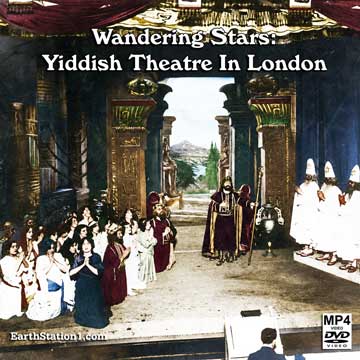
The Vibrant History Of Yiddish Theatre In London During Its Heyday In London's East End And Its Theatrical Temples, The Grand Palais, The New Yiddish Theatre And The Pavilion Theatre Whitechapel! Another VHS-Era Classic Collection From The Golden Age Of Cable Television, Presented In Our Highest DVD Quality MPEG Video Format At 9.1 MBPS As A MP4 Video Download Or Archival Quality All Regions Format DVD! (Color, 1987, 35 Minutes.) #WanderingStars #YiddishTheatreInLondon #YiddishTheatre #JewishTheatre #YiddishCulture #JewishCulture #GrandPalais #NewYiddishTheatre #PavilionTheatreWhitechapel #KingOfLampedusa #EastEnd #London #Theatre #Stage #MP4 #VideoDownload #DVD
Yiddish Theatre In London: Yiddish theatre once thrived in London's East End, serving as a cultural hub for Jewish immigrants and a place where they could speak and hear their "Mamalushen" (mother tongue). The language, a blend of German, Russian, Hebrew, and other dialects, was central to the community's identity, and Yiddish plays offered a mix of comedy, drama, and music that provided both entertainment and emotional release. Its historical venues included The New Yiddish Theatre (Adler Street) - Opened in 1936 as the Jewish National Theatre, relaunched in 1943, and closed in 1947 due to roof repairs; The Grand Palais Yiddish Theatre (Commercial Road) - One of the longest-surviving venues, producing Yiddish plays until 1970, including a record-breaking six-month run of The King of Lampedusa; and The Pavilion Theatre (Whitechapel); other East End theatres also hosted Yiddish productions These venues drew large crowds, often queuing for hours, and featured everything from Shakespearean adaptations to political plays and folk tales Londonist. The Yiddish theatre scene faded as the East End's Jewish population dispersed, the war damaged infrastructure, and the cultural landscape shifted Londonist. Today, the legacy is largely remembered through archives, photographs, and historical accounts. Revival Efforts In recent years, there has been a push to revive Yiddish theatre in London: The Yiddish Cafe Trust - Launched a Yiddish Theatre Initiative in 2024, partnering with UCL and JW3 to host workshops, readings, and performances yiddishcafe.com; The London Shpilers - A new troupe formed from the initiative, debuting in 2026 with a mix of new writing, sketches, and Yiddish classics UCL; and The Season of Yiddish Theatre (2024) - Featured Secrets of the London Yiddish Stage, Mirele Efros (Jacob Gordin), and Miryeml (Tea Arciszewska), alongside workshops and translations. While there is no permanent Yiddish theatre company in London today, these initiatives aim to build a troupe and sustain the art form. Performances are often in English with Yiddish excerpts, making them accessible to non-speaker. Yiddish theatre in London was once a vibrant, community-driven art form in the East End, but it has been revived through collaborative projects that blend history, performance, and education, keeping the spirit of the “Jargon theatre” alive.
Yiddish Theatre consists of plays written and performed primarily by Ashkenazi Jews in the Yiddish language. The range of Yiddish Theatre is broad: operetta, musical comedy, and satiric or nostalgic revues; melodrama; naturalist drama; expressionist and modernist plays. At its height, its geographical scope was comparably broad: from the late 19th century until just before World War II, professional Yiddish Theatre could be found throughout the heavily Jewish areas of Eastern and East Central Europe, but also in Berlin, London, Paris, Buenos Aires and New York City. Yiddish Theatre's roots include the often satiric plays traditionally performed during religious holiday of Purim (known as Purimshpils); the singing of cantors in the synagogues; Jewish secular song and dramatic improvisation; exposure to the theatre traditions of various European countries, and the Jewish literary culture that had grown in the wake of the Jewish enlightenment (Haskalah). Israil Bercovici wrote that it is through Yiddish Theatre that "Jewish culture entered in dialogue with the outside world," both by putting itself on display and by importing theatrical pieces from other cultures. Themes such as immigration, poverty, integration, and strong ancestral ties can be found in many Yiddish Theatre productions.
New Permanent Price Reductions!
Launching Our Summer "I Never Knew That Existed!" Days!
A New Commitment From EarthStation1.com!
Issued Sunday, June 28, 2026
For thirty years, EarthStation1.com has existed for one purpose: to preserve, curate, and share the history of our world through television, radio, film, and documentary media. During that time, the world has changed dramatically. The cost of nearly everything has risen, and for many people, simply making ends meet has become more difficult than ever. We believe that learning, discovery, and the enjoyment of history should never become luxuries reserved only for those who can afford them.
Beginning today, EarthStation1.com is introducing a new long-term pricing philosophy. Rather than asking, "What is the highest price people will pay?" we are asking a different question: "What is the fairest price that allows the greatest number of people to own, enjoy, and preserve these remarkable programs?" We want students, teachers, veterans, researchers, families, collectors, and lifelong learners everywhere to have access to the extraordinary stories that have shaped our world—without price becoming an unnecessary barrier.
This is more than a sale. It is a commitment to the future of EarthStation1.com and to the people we have proudly served since 1996. Our hope is simple: that by making our catalog more affordable than ever before, we can place more history into more homes, encourage greater understanding of our shared past, and ensure that these important films, broadcasts, and recordings continue to educate and inspire for generations to come. We invite you to explore our collection, rediscover old favorites, uncover new treasures, and join us as we begin this exciting new chapter together.
— Sam Fellowes
Executive Director of Customer Experience
EarthStation1.com

***** BAAAAHH-DAH-DAH-DAAAAAAHHHH!!! *****
HERALD: Hear ye! Hear ye! Let it be proclaimed throughout the Known and Unknown Universe!
By decree of the Curator of EarthStation1.com™, and with the enthusiastic concurrence of the Executive Director of Customer Experience...
Henceforth shall the proclamation read:
15% (Or More!) Daily Specials
...and there was much rejoicing among historians, documentary enthusiasts, collectors, lovers of old television and radio, seekers of the obscure, and all who delight in discovering the treasures of the past without having to mortgage the present.
The fanfare crescendos... banners unfurl... somewhere, Yul Brynner nods approvingly... and Cecil B. DeMille quietly murmurs, "Print it."
Copyright © 1996-2026 J. C. Kaelin, Jr., Proprietor, EarthStation1.com and MediaOutlet.com.
[Our motto and graphic by Sam Fellowes (2026).]