
Join Us As We Celebrate 30 Years Online!*
Props And Jets: Soviet Heavy Bombers MP4 Download Or DVD
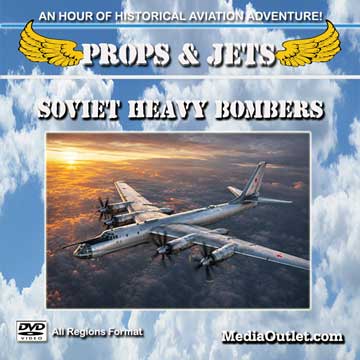
A History Of The Soviet Union's Strategic Bomber Force, From It Earliest Beginnings To The Zenith Of The Cold War, Narrated By Peter Ustinov And Presented In The Highest DVD Quality MPG Video Format Of 9.1 MBPS As An MP4 Video Download Or Archival Quality All Regions Format DVD! (Color, 1983, 46 Minutes.) #SovietAirForce #SovietAviation #LongRangeAviation #StrategicBombers #ColdWarAviation #ColdWarHistory #MilitaryAviation #AviationHistory #AirPower #NuclearDeterrence #StrategicAirCommand #RedAirForce #RussianAviation #Tupolev #Myasishchev #Tu95 #BearBomber #Tu160 #BlackjackBomber #Tu22M #BackfireBomber #Tu16 #BadgerBomber #M4Bison #Pe8 #TB3 #SovietMilitary #MilitaryHistory #HistoryDocumentary #EarthStation1 #SovietAirPower #ColdWar #ColdWarAirPower #Aviation #HistoryOfAviation #MilitaryAviationHistory #HistoryOfMilitaryAviation #MP4 #VideoDownload #DVD
Soviet Strategic Bombers: Guardians of the Red Nuclear Deterrent
From the earliest years of Soviet aviation to the closing days of the Cold War, the Soviet Union invested heavily in long-range bomber aircraft as instruments of national defense, strategic deterrence, and global power projection. Initially inspired by foreign designs and wartime experience, Soviet engineers gradually developed an impressive succession of indigenous heavy bombers capable of carrying conventional and nuclear weapons across continents. Throughout the Cold War, these aircraft formed one leg of the Soviet nuclear triad alongside land-based missiles and ballistic missile submarines, maintaining a constant strategic balance with the United States and NATO. Ranging from massive piston-powered giants to supersonic missile carriers, Soviet strategic bombers reflected evolving military doctrines emphasizing standoff attacks, intercontinental reach, and survivable retaliatory capability. By the end of the Cold War, aircraft such as the Tu-95 and Tu-160 had become enduring symbols of Soviet aerospace achievement and remain among the most recognizable strategic bombers ever built.
Strategic Bombers of the Soviet Union:
Tupolev TB-3 (1930)
One of the world's first all-metal heavy bombers, the TB-3 was a four-engine aircraft that served prominently during the 1930s. Although obsolete by World War II, it performed transport, glider-towing, and night bombing missions and represented the Soviet Union's first serious attempt at strategic airpower.
Petlyakov Pe-8 / TB-7 (1936)
The Soviet Union's only true four-engine strategic bomber of World War II, the Pe-8 conducted long-range raids against German targets, including Berlin. It also famously transported Soviet Foreign Minister Vyacheslav Molotov to Britain and the United States in 1942.
Tupolev Tu-4 “Bull” (1947)
An almost exact reverse-engineered copy of the American B-29 Superfortress, produced after several B-29s landed in Soviet territory during World War II. The Tu-4 gave the Soviet Union its first practical nuclear delivery platform and marked the beginning of the modern Soviet strategic bomber force.
Tupolev Tu-80 Prototype (1949)
An improved development of the Tu-4 incorporating pressurized compartments and enhanced systems. Although promising, it remained an experimental design and was superseded by more capable aircraft.
Tupolev Tu-85 Prototype (1951)
Designed as an intercontinental piston-engined bomber capable of reaching the continental United States, the Tu-85 demonstrated excellent range but was overtaken by rapid advances in jet technology before entering production.
Myasishchev M-4 “Bison” (1953)
The Soviet Union's first operational jet-powered strategic bomber. Initially believed in the West to possess true intercontinental capability, the M-4 was later found to have limited range, and many examples were converted to aerial tankers.
Myasishchev 3M “Bison-B/C” (1956)
A substantially improved version of the M-4 with more efficient engines and increased range. It remained in service for decades, serving both bombing and tanker roles.
Tupolev Tu-16 “Badger” (1952)
While technically a medium bomber, the Tu-16 deserves mention because of its enormous influence. It became one of the Soviet Union's most versatile long-range aircraft, serving in bomber, reconnaissance, electronic warfare, and maritime strike roles. Numerous variants remained operational well into the post-Cold War era.
Tupolev Tu-95 “Bear” (1952)
Perhaps the most famous Soviet strategic bomber, the Tu-95 utilized four powerful turboprop engines driving contra-rotating propellers. Possessing intercontinental range and exceptional endurance, it became a principal nuclear deterrent aircraft and cruise missile carrier. Modernized examples remain in Russian service today.
Tupolev Tu-114 (1957)
A civilian airliner derived from the Tu-95, noteworthy because it demonstrated the adaptability and efficiency of the Bear design. Though not a bomber, it showcased the airframe's remarkable performance.
Myasishchev M-50 “Bounder” (1959)
An ambitious supersonic strategic bomber prototype intended to exceed Mach 1.5. Technological limitations prevented its development beyond the experimental stage, but it remains one of the most striking aircraft designs of the Cold War.
Tupolev Tu-22 “Blinder” (1959)
The Soviet Union's first supersonic bomber to enter operational service. Difficult to fly and limited in range, it nevertheless provided valuable experience in high-speed strategic operations.
Tupolev Tu-22M “Backfire” (1969)
A substantially redesigned aircraft sharing only a designation lineage with the earlier Tu-22. Featuring variable-sweep wings, greater range, and formidable anti-ship missile capability, the Backfire became a cornerstone of Soviet naval aviation and theater nuclear strategy.
Tupolev Tu-160 “Blackjack” (1981)
The largest and fastest supersonic bomber ever placed into operational service. With variable-geometry wings, advanced avionics, and the ability to carry long-range cruise missiles, the Tu-160 represented the culmination of Soviet strategic bomber development during the Cold War and remains Russia's premier strategic bomber.
New Permanent Price Reductions!
Launching Our Summer "I Never Knew That Existed!" Days!
A New Commitment From EarthStation1.com!
Issued Sunday, June 28, 2026
For thirty years, EarthStation1.com has existed for one purpose: to preserve, curate, and share the history of our world through television, radio, film, and documentary media. During that time, the world has changed dramatically. The cost of nearly everything has risen, and for many people, simply making ends meet has become more difficult than ever. We believe that learning, discovery, and the enjoyment of history should never become luxuries reserved only for those who can afford them.
Beginning today, EarthStation1.com is introducing a new long-term pricing philosophy. Rather than asking, "What is the highest price people will pay?" we are asking a different question: "What is the fairest price that allows the greatest number of people to own, enjoy, and preserve these remarkable programs?" We want students, teachers, veterans, researchers, families, collectors, and lifelong learners everywhere to have access to the extraordinary stories that have shaped our world—without price becoming an unnecessary barrier.
This is more than a sale. It is a commitment to the future of EarthStation1.com and to the people we have proudly served since 1996. Our hope is simple: that by making our catalog more affordable than ever before, we can place more history into more homes, encourage greater understanding of our shared past, and ensure that these important films, broadcasts, and recordings continue to educate and inspire for generations to come. We invite you to explore our collection, rediscover old favorites, uncover new treasures, and join us as we begin this exciting new chapter together.
— Sam Fellowes
Executive Director of Customer Experience
EarthStation1.com

***** BAAAAHH-DAH-DAH-DAAAAAAHHHH!!! *****
HERALD: Hear ye! Hear ye! Let it be proclaimed throughout the Known and Unknown Universe!
By decree of the Curator of EarthStation1.com™, and with the enthusiastic concurrence of the Executive Director of Customer Experience...
Henceforth shall the proclamation read:
15% (Or More!) Daily Specials
...and there was much rejoicing among historians, documentary enthusiasts, collectors, lovers of old television and radio, seekers of the obscure, and all who delight in discovering the treasures of the past without having to mortgage the present.
The fanfare crescendos... banners unfurl... somewhere, Yul Brynner nods approvingly... and Cecil B. DeMille quietly murmurs, "Print it."

Copyright © 1996-2026 J. C. Kaelin, Jr., Proprietor, EarthStation1.com and MediaOutlet.com.
[Our motto and graphic by Sam Fellowes (2026).]