
Join Us As We Celebrate 30 Years Online!*
Long Shadows: American Civil War Legacy + Johnson Impeachment MP4 DVD
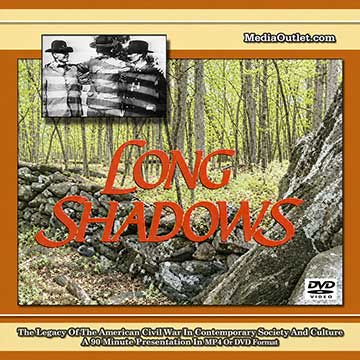
The Legacy Of The American Civil War In Society And Culture Known As The Reconstruction Era, And Its Affect On Both The North And The South, As Seen In America's Popular Culture, Political World View, Regional Culture Clashes And The Arts, With Great Exclusive Footage Of President Jimmy Carter, Robert Penn Warren, Studs Terkel, John Hope Franklin, James Reston Jr., C. Vann Woodward, Robert Coles, Albert Murray And Tom Wicker (Color, 1987, 1 Hour 28 Minutes) PLUS BONUS: YOU ARE THERE: UNITED STATES SENATE, WASHINGTON, D.C.: THE IMPEACHMENT VOTE OF ANDREW JOHNSON: MAY 16, 1868: Hypothetical News Coverage Of The U.S. Senate's Vote On The Article Of Impeachment Against President Andrew Johnson And Its Failure By One Vote To Gain The 2/3rds Majority Vote Necessary To Convict Him, As Told In This Episode Of The Renowned 1947-50 Weekly Historical Dramatization Series By The Famed World War II Staff Of CBS News, Here Narrated By John Charles Daly, The First National Correspondent To Report The Attack On Pearl Harbor And The Death Of President Franklin D. Roosevelt (Audio Only, June 20, 1948, 29 Minutes) -- All Presented In Our Highest DVD Quality MPEG Video Format At 9.1 MBPS As A MP4 Video Download Or Archival Quality All Regions Format DVD! #ReconstructionEra #Reconstruction #AftermathOfTheAmericanCivilWar #AmericanCivilWarLegacy #AmericanCivilWar #WarBetweenTheStates #JimmyCarter #RobertPennWarren #StudsTerkel #JohnHopeFranklin #JamesRestonJr #CVannWoodward #RobertColes #AlbertMurray #TomWicker #AmericanHistory #USHistory #HistoryOfTheUS #ImpeachmentOfAndrewJohnson #AndrewJohnson #Impeachment #POTUS #POTUSHistory #AmericanPresidents #USPresidents #WesternCulture #WesternCivilization #OccidentalCulture #WesternWorld #WesternSociety #WesternTradition #StoryOfCivilization #YouAreThere #YouAreThereRadioSeries #Radio #OldTimeRadio #OTR #MP4 #VideoDownload #DVD
*August 23, 2026: Expanded To Include YOU ARE THERE: UNITED STATES SENATE, WASHINGTON, D.C.: THE IMPEACHMENT VOTE OF ANDREW JOHNSON!
The Reconstruction Era, the period in American history that lasted from 1865 to 1877 following the American Civil War (1861–65), marked a significant chapter in the history of civil rights in the United States. Reconstruction ended the remnants of Confederate secession and abolished slavery, making the newly freed slaves citizens with civil rights ostensibly guaranteed by three new constitutional amendments. Reconstruction also refers to the attempt to transform the 11 Southern, former Confederate states, as directed by Congress, and the role of the Union states in that transformation. The American Civil War left a legacy that has shaped the politics, culture, racial relations, regional identities, and historical memory of the United States from Reconstruction to the present day. Although the fighting ended in 1865, Americans in both the North and South spent generations debating what the war had meant, what had caused it, what victory and defeat required, and how the reunited nation should remember slavery, emancipation, secession, and the enormous human cost of the conflict. During Reconstruction, from 1865 to 1877, the immediate legacy of the war centered upon the transformation of Southern society and the status of approximately four million formerly enslaved African Americans. The Thirteenth Amendment abolished slavery, the Fourteenth established national citizenship and equal protection under the law, and the Fifteenth prohibited denying the vote on the basis of race. With federal military protection and the support of the Freedmen's Bureau, Black Americans established churches, schools, businesses, families, political organizations, and communities and participated in government on an unprecedented scale. Southern resistance, however, was intense. Organizations including the Ku Klux Klan used terror and violence against Black citizens and white Republicans, while many former Confederates sought to restore as much of the antebellum racial and social order as possible. In the North, the Union victory initially strengthened nationalism and made preservation of the United States one of the central themes of Civil War memory. Abraham Lincoln became an increasingly revered national figure, while Union veterans and organizations such as the Grand Army of the Republic helped establish Memorial Day traditions and preserved the memory of those who had fought to save the Union. Yet Northern commitment to Reconstruction and Black civil rights gradually weakened. By the late nineteenth century, many white Northerners increasingly emphasized sectional reconciliation with white Southerners rather than the unfinished struggle for racial equality that had been central to emancipation. In the South, Confederate defeat became the foundation of a powerful regional memory commonly known as the Lost Cause. Former Confederates and organizations devoted to Confederate commemoration portrayed the Southern cause as honorable and frequently minimized or denied slavery's central role in secession and the war. Confederate monuments were erected across the South, particularly during the late nineteenth and early twentieth centuries, while Confederate leaders such as Robert E. Lee were elevated into regional heroes. This interpretation accompanied the rise of segregation, disfranchisement, racial violence, and the Jim Crow system that increasingly deprived Black Southerners of many of the political and civil rights won during Reconstruction. By the early twentieth century, a national culture of reconciliation between white Northerners and white Southerners had developed. Veterans of the Union and Confederate armies met at battlefield reunions, and the courage of soldiers on both sides was celebrated as part of a shared American heritage. This reconciliation helped heal sectional hostility, but it often did so by marginalizing African American experiences and obscuring the central importance of slavery and emancipation. Popular literature, historical writing, monuments, school textbooks, and eventually motion pictures helped establish romanticized images of both the antebellum South and the Confederate cause. Works such as The Birth Of A Nation and Gone With The Wind became enormously influential examples of the way Civil War memory entered American popular culture. African Americans maintained a very different historical memory. For them, the Civil War remained fundamentally a struggle that destroyed slavery and transformed the meaning of American freedom. The service of nearly 180,000 Black soldiers in the Union Army, the promise of Reconstruction, and the constitutional amendments produced by the war became essential parts of the African American struggle for citizenship. During the twentieth-century Civil Rights Movement, activists repeatedly invoked the Fourteenth and Fifteenth Amendments and described their struggle as an effort to fulfill promises that had remained incomplete since Reconstruction. The Civil War consequently reentered American political life with particular force during the civil rights era. Battles over school integration, voting rights, federal authority, and racial equality revived arguments concerning states' rights and national power that carried echoes of nineteenth-century sectional conflict. Confederate flags and symbols also became increasingly controversial. To some white Southerners they represented regional identity, ancestry, or remembrance; to many African Americans and other Americans they represented slavery, segregation, racial oppression, and resistance to civil rights. From the late twentieth century into the twenty-first, historical scholarship increasingly emphasized slavery as the central cause of secession and the Civil War, while historians gave considerably greater attention to emancipation, African American soldiers, enslaved people, women, civilians, Reconstruction, and the long struggle over citizenship. At the same time, public debates over Confederate monuments, battlefield interpretation, flags, school curricula, historical terminology, and commemorations demonstrated that the war remained part of America's living political and cultural memory rather than merely a distant historical event. The war's legacy therefore developed differently in the North and South but ultimately became inseparable from the history of the nation as a whole. In the North, remembrance traditionally emphasized preservation of the Union, Lincoln, emancipation, and Union military sacrifice. In the South, memory was shaped for generations by military defeat, Confederate remembrance, regional pride, the Lost Cause tradition, and the profound social upheaval caused by emancipation and Reconstruction. African American memory preserved another essential perspective: the Civil War as a revolutionary destruction of slavery whose promises of freedom and equal citizenship remained only partially fulfilled for generations afterward. More than a century and a half after Appomattox, Americans continue to debate the Civil War because many of the fundamental questions raised by the conflict remain central to American society: the relationship between federal and state authority, the meaning of citizenship, racial equality, voting rights, national identity, historical memory, and the interpretation of the Constitution. In that sense, the Civil War did not simply end in 1865. Its military struggle concluded, but its political, social, and cultural consequences became part of the continuing American experience.
May 26, 1868: Federal Impeachments In The United States: The Reconstruction Era (Reconstruction): The Impeachment Of Andrew Johnson: -- United States President Andrew Johnson impeachment trial ends with his acquittal by one vote after a ten-day recess was called by the United States Senate before they attempted to convict him on additional articles from the ones that they failed to impeach him on when they voted on a different article of impeachment on May 16. The Impeachment of Andrew Johnson occurred in 1868, when the United States House Of Representatives resolved to impeach President Andrew Johnson, adopting eleven articles of impeachment detailing his "high crimes and misdemeanors," in accordance with Article Two of the United States Constitution. The House's primary charge against Johnson was violation of the Tenure of Office Act, passed by the U.S. Congress in March 1867, over the president's veto. Specifically, he had removed from office Edwin M. Stanton, the Secretary of War - whom the Act was largely designed to protect - and attempted to replace him with Brevet Major General Lorenzo Thomas (Earlier, while Congress was not in session, Johnson had suspended Stanton and appointed General Ulysses S. Grant as secretary of war ad interim). The House approved the articles of impeachment on March 2-3, 1868, and forwarded them to the Senate. The trial in the Senate began three days later, with Chief Justice of the United States Salmon P. Chase presiding. On May 16, the Senate failed to convict Johnson on one of the articles, with the 35-19 vote in favor of conviction falling short of the necessary two-thirds majority by a single vote. A ten-day recess was called before attempting to convict him on additional articles. The delay did not change the outcome, however, as on May 26, it failed to convict the President on two articles, both by the same margin; after which the trial was adjourned. This was the first impeachment of a President since creation of the office in 1789. The culmination of a lengthy political battle between Johnson, a lifelong Democrat and the Republican majority in Congress over how best to deal with the defeated Southern states following the conclusion of the American Civil War, the impeachment, and the subsequent trial (and acquittal) of Johnson were among the most dramatic events in the political life of the nation during the Reconstruction Era. Together, they have gained a historical reputation as an act of political expedience, rather than necessity, which was based on Johnson's defiance of an unconstitutional piece of legislation, and which was conducted with little regard for the will of a general public which, despite the unpopularity of Johnson, opposed the impeachment. Johnson is one of only three presidents against whom articles of impeachment have been reported to the full House for consideration. In 1974, during the Watergate scandal, the House Judiciary Committee approved articles of impeachment against Richard Nixon, who resigned from office, rather than face certain impeachment and the prospect of being convicted at trial and removed from office. In 1998, Bill Clinton was impeached; he, like Johnson, was acquitted of all charges following a Senate trial in 1999.
New Permanent Price Reductions!
Launching Our Summer "I Never Knew That Existed!" Days!
A New Commitment From EarthStation1.com!
Issued Sunday, June 28, 2026
For thirty years, EarthStation1.com has existed for one purpose: to preserve, curate, and share the history of our world through television, radio, film, and documentary media. During that time, the world has changed dramatically. The cost of nearly everything has risen, and for many people, simply making ends meet has become more difficult than ever. We believe that learning, discovery, and the enjoyment of history should never become luxuries reserved only for those who can afford them.
Beginning today, EarthStation1.com is introducing a new long-term pricing philosophy. Rather than asking, "What is the highest price people will pay?" we are asking a different question: "What is the fairest price that allows the greatest number of people to own, enjoy, and preserve these remarkable programs?" We want students, teachers, veterans, researchers, families, collectors, and lifelong learners everywhere to have access to the extraordinary stories that have shaped our world—without price becoming an unnecessary barrier.
This is more than a sale. It is a commitment to the future of EarthStation1.com and to the people we have proudly served since 1996. Our hope is simple: that by making our catalog more affordable than ever before, we can place more history into more homes, encourage greater understanding of our shared past, and ensure that these important films, broadcasts, and recordings continue to educate and inspire for generations to come. We invite you to explore our collection, rediscover old favorites, uncover new treasures, and join us as we begin this exciting new chapter together.
— Sam Fellowes
Executive Director of Customer Experience
EarthStation1.com

***** BAAAAHH-DAH-DAH-DAAAAAAHHHH!!! *****
HERALD: Hear ye! Hear ye! Let it be proclaimed throughout the Known and Unknown Universe!
By decree of the Curator of EarthStation1.com™, and with the enthusiastic concurrence of the Executive Director of Customer Experience...
Henceforth shall the proclamation read:
15% (Or More!) Daily Specials
...and there was much rejoicing among historians, documentary enthusiasts, collectors, lovers of old television and radio, seekers of the obscure, and all who delight in discovering the treasures of the past without having to mortgage the present.
The fanfare crescendos... banners unfurl... somewhere, Yul Brynner nods approvingly... and Cecil B. DeMille quietly murmurs, "Print it."
Copyright © 1996-2026 J. C. Kaelin, Jr., Proprietor, EarthStation1.com and MediaOutlet.com.
[Our motto and graphic by Sam Fellowes (2026).]