
Join Us As We Celebrate 30 Years Online!*
Fyodor Dostoevsky: Crime And Punishment & The Gambler: MP4 Or DVD
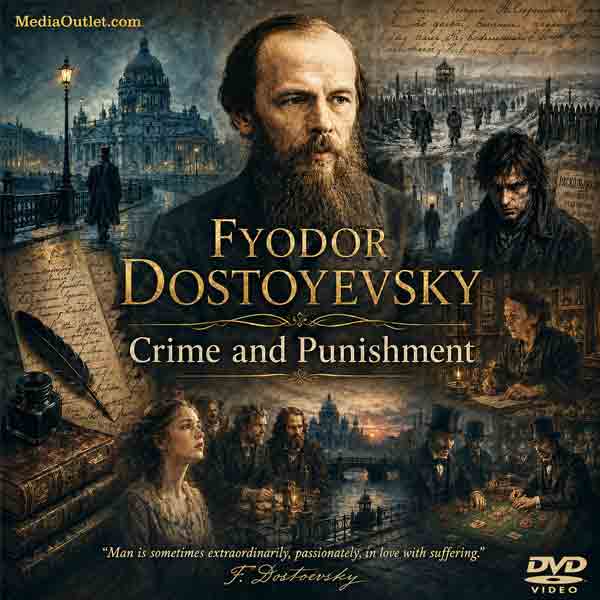
The Life And Art Of The Great Russian Novelist, Short Story Writer, Essayist, Journalist And Philosopher As Seen Through The Lens Of His Landmark Work "Crime and Punishment:(Color, 1988, 45 Minutes) PLUS 2 Bonus Titles: 1) The NBC Radio Play Adaptation Of His Semi-Autobiographical Novel THE GAMBLER, In The Landmark Peabody Award Winning Literary Radio Drama Series "NBC University Theater Of The Air! For Their College-By-Radio Course In American And British Fiction (Wednesday, December 27, 1950, 30 Minutes), And 2) GREAT POETS: DOSTOIEVSKI (Color, 1988, 10 Minutes) -- All Presented In Our Highest DVD Quality MPEG Video Format Of 9.1 MBPS As A 2 Volume Video Download MP4 Set Or A 2 Disc Archival Quality All Regions Format DVD Set! (1 Hours 25 Minutes Total.) #FyodorDostoyevsky #Dostoyevsky #FyodorDostoevsky #CrimeAndPunishment #TheGambler #Philosophy #Authors #Novelists #Essayists #Journalists #Literature #RussianLiterature #MP4 #VideoDownload #DVD
*July 28, 2026: Expanded And Upgraded: Expanded To Include NBC UNIVERSITY THEATER OF THE AIR: THE GAMBLER, And Upgraded From A Standard Format DVD To An Archival Quality Dual Layer Format DVD!
Crime And Punishment is a novel by the Russian author Fyodor Dostoevsky. It was first published in the literary journal The Russian Messenger in twelve monthly installments during 1866. It was later published in a single volume. It is the second of Dostoevsky's full-length novels following his return from ten years of exile in Siberia. Crime and Punishment is considered the first great novel of his mature period of writing and is often cited as one of the greatest works of world literature. Crime and Punishment follows the mental anguish and moral dilemmas of Rodion Raskolnikov, an impoverished former law student in Saint Petersburg who plans to kill an unscrupulous pawnbroker, an old woman who stores money and valuable objects in her flat. He theorises that with the money he could liberate himself from poverty and go on to perform great deeds, and seeks to convince himself that certain crimes are justifiable if they are committed in order to remove obstacles to the higher goals of "extraordinary" men. Once the deed is done, however, he finds himself wracked with confusion, paranoia, and disgust. His theoretical justifications lose all their power as he struggles with guilt and horror and is confronted with both internal and external consequences of his deed.
The Gambler is a short novel by Fyodor Dostoevsky about a young tutor in the employment of a formerly wealthy Russian general. Set in a hotel and casino in a German city, the theme of gambling reflects Dostoevsky's own experience of addiction to roulette. Dostoevsky completed the novel in 1866 under a strict deadline to pay off gambling debts. Dostoevsky gambled for the first time at the tables at Wiesbaden in 1863. From that time till 1871, when his passion for gambling subsided, he played at Baden-Baden, Homburg, and Saxon-les-Bains frequently, often beginning by winning a small amount of money and losing far more in the end. Dostoevsky agreed to a hazardous contract with F. T. Stellovsky that if he did not deliver a novel of 12 or more signatures by November 1, 1866, Stellovsky would acquire the right to publish Dostoevsky's works for nine years, until November 1, 1875, without any compensation to the writer. He noted down parts of his story, then dictated them to one of the first stenographers in Russia, the 19 year old Anna Grigorevna Snitkina, who transcribed them and copied it neatly out for him. With her help, he was able to finish the book in time. Anna later became his wife.
Fyodor Dostoyevsky, sometimes transliterated Dostoevsky, Russian novelist, short story writer, essayist, journalist and philosopher (November 11, 1821 - February 9, 1881) was born Fyodor Mikhailovich Dostoyevsky in Moscow to a noble Russian Orthodox Christian family. Dostoyevsky's literary works explore human psychology in the troubled political, social, and spiritual atmospheres of 19th-century Russia, and engage with a variety of realistic philosophical and religious themes. His most acclaimed works include Crime and Punishment (1866), The Idiot (1869), Demons (1872) and The Brothers Karamazov (1880). Dostoyevsky's oeuvre consists of 11 novels, three novellas, 17 short stories and numerous other works. Many literary critics rate him as one of the greatest psychologists in world literature. His 1864 novella Notes from Underground is considered to be one of the first works of existentialist literature. Arrested in 1849 for belonging to a literary group that discussed banned books critical of "Tsarist Russia", he was sentenced to death but the sentence was commuted at the last moment. He spent four years in a Siberian prison camp, followed by six years of compulsory military service in exile. In the following years, Dostoyevsky worked as a journalist, publishing and editing several magazines of his own and later A Writer's Diary, a collection of his writings. He began to travel around western Europe and developed a gambling addiction, which led to financial hardship. For a time, he had to beg for money, but he eventually became one of the most widely read and highly regarded Russian writers. His books have been translated into more than 170 languages. Dostoyevsky was influenced by a wide variety of philosophers and authors including Pushkin, Gogol, Augustine, Shakespeare, Dickens, Balzac, Lermontov, Hugo, Poe, Plato, Cervantes, Herzen, Kant, Belinsky, Hegel, Schiller, Solovyov, Bakunin, Sand, Hoffmann, and Mickiewicz. His writings were widely read both within and beyond his native Russia and influenced an equally great number of later writers including Russians like Aleksandr Solzhenitsyn and Anton Chekhov as well as philosophers such as Friedrich Nietzsche and Jean-Paul Sartre. Fyodor Dostoyevsky died of a pulmonary hemorrhages (hemorrhages of the lung). His last words to his wife Anna were: "Remember, Anya, I have always loved you passionately and have never been unfaithful to you ever, even in my thoughts!" He is interred in the Tikhvin Cemetery at the Alexander Nevsky Convent, near his favourite poets, Nikolay Karamzin and Vasily Zhukovsky. It is unclear how many attended his funeral. According to one reporter, more than 100,000 mourners were present, while others describe attendance between 40,000 and 50,000. His tombstone is inscribed with lines from the New Testament: "Verily, verily, I say unto you, Except a corn of wheat fall into the ground and die, it abideth alone: but if it dies, it bringeth forth much fruit."
New Permanent Price Reductions!
Launching Our Summer "I Never Knew That Existed!" Days!
A New Commitment From EarthStation1.com!
Issued Sunday, June 28, 2026
For thirty years, EarthStation1.com has existed for one purpose: to preserve, curate, and share the history of our world through television, radio, film, and documentary media. During that time, the world has changed dramatically. The cost of nearly everything has risen, and for many people, simply making ends meet has become more difficult than ever. We believe that learning, discovery, and the enjoyment of history should never become luxuries reserved only for those who can afford them.
Beginning today, EarthStation1.com is introducing a new long-term pricing philosophy. Rather than asking, "What is the highest price people will pay?" we are asking a different question: "What is the fairest price that allows the greatest number of people to own, enjoy, and preserve these remarkable programs?" We want students, teachers, veterans, researchers, families, collectors, and lifelong learners everywhere to have access to the extraordinary stories that have shaped our world—without price becoming an unnecessary barrier.
This is more than a sale. It is a commitment to the future of EarthStation1.com and to the people we have proudly served since 1996. Our hope is simple: that by making our catalog more affordable than ever before, we can place more history into more homes, encourage greater understanding of our shared past, and ensure that these important films, broadcasts, and recordings continue to educate and inspire for generations to come. We invite you to explore our collection, rediscover old favorites, uncover new treasures, and join us as we begin this exciting new chapter together.
— Sam Fellowes
Executive Director of Customer Experience
EarthStation1.com

***** BAAAAHH-DAH-DAH-DAAAAAAHHHH!!! *****
HERALD: Hear ye! Hear ye! Let it be proclaimed throughout the Known and Unknown Universe!
By decree of the Curator of EarthStation1.com™, and with the enthusiastic concurrence of the Executive Director of Customer Experience...
Henceforth shall the proclamation read:
15% (Or More!) Daily Specials
...and there was much rejoicing among historians, documentary enthusiasts, collectors, lovers of old television and radio, seekers of the obscure, and all who delight in discovering the treasures of the past without having to mortgage the present.
The fanfare crescendos... banners unfurl... somewhere, Yul Brynner nods approvingly... and Cecil B. DeMille quietly murmurs, "Print it."
Copyright © 1996-2026 J. C. Kaelin, Jr., Proprietor, EarthStation1.com and MediaOutlet.com.
[Our motto and graphic by Sam Fellowes (2026).]