
Join Us As We Celebrate 30 Years Online!*
An Astronaut's View Of Earth W/William Shatner MP4 Video Download DVD
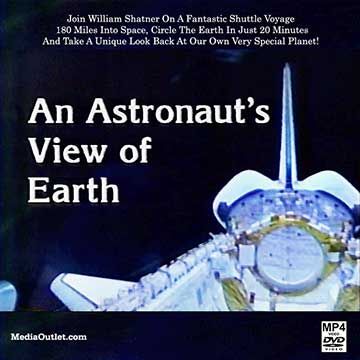
The Earth From Space -- An Extraordinary Sight Experienced By Only A Handful Of People -- Until Now! William Shatner Is Your Guide On A Fantastic Space Shuttle Voyage Where You Will Blast 180 Miles Into Orbit, Circle The Earth In Just 20 Minutes And Take A Unique Look Back At Our Own Very Special Planet! Astronauts John Glenn, Charles Bolden And More Share Their Experiences And Insights Into What Earth Is From A Celestial Vantage Point Where You Can See Both The Forest And Its Trees, With Awe-Inspiring Video Of The Earth Streaming Below, Set To The Music Of David Byrne And Pat Irwin -- All Presented In The Highest DVD Quality MPG Video Format Of 9.1 MBPS As An MP4 Video Download Or Archival Quality All Regions Format DVD! (Color, 1992, 50 Minutes.) #AnAstronaut'sViewOfEarth #WilliamShatner #JohnGlenn #CharlesBolden #DavidByrne #PatIrwin #Astronauts #SpaceShuttle #SpaceShuttleProgram #NASA #NASAHistory #Spaceflight #SpaceExploration #Earth #TheEarth #MannedSpaceProgram #HumanSpaceflight #HumanSpaceflightPrograms #MP4 #VideoDownload #DVD
Earth is the third planet from the Sun and the only astronomical object known to science to harbor life. This is made possible by Earth being an ocean world, the only one in the Solar System sustaining liquid surface water. Almost all of Earth's water is contained in its global ocean, covering 70.8% of Earth's crust. The remaining 29.2% of Earth's crust is land, most of which is located in the form of continental landmasses within Earth's land hemisphere. Most of Earth's land is at least somewhat humid and covered by vegetation, while large ice sheets at Earth's polar deserts retain more water than Earth's groundwater, lakes, rivers, and atmospheric water combined. Earth's crust consists of slowly moving tectonic plates, which interact to produce mountain ranges, volcanoes, and earthquakes. Earth has a liquid outer core that generates a magnetosphere capable of deflecting most of the destructive solar winds and cosmic radiation. Earth has a dynamic atmosphere, which sustains Earth's surface conditions and protects it from most meteoroids and UV-light at entry. It is composed primarily of nitrogen and oxygen. Water vapor is widely present in the atmosphere, forming clouds that cover most of the planet. The water vapor acts as a greenhouse gas and, together with other greenhouse gases in the atmosphere, particularly carbon dioxide (CO2), creates the conditions for both liquid surface water and water vapor to persist via the capturing of energy from the Sun's light. This process maintains the current average surface temperature of 14.76 _C (58.57 _F), at which water is liquid under normal atmospheric pressure. Differences in the amount of captured energy between geographic regions (as with the equatorial region receiving more sunlight than the polar regions) drive atmospheric and ocean currents, producing a global climate system with different climate regions, and a range of weather phenomena such as precipitation, allowing components such as carbon and nitrogen to cycle. Earth is rounded into an ellipsoid with a circumference of about 40,000 kilometers (24,900 miles). It is the densest planet in the Solar System. Of the four rocky planets, it is the largest and most massive. Earth is about eight light-minutes (1 AU) away from the Sun and orbits it, taking a year (about 365.25 days) to complete one revolution. Earth rotates around its own axis in slightly less than a day (in about 23 hours and 56 minutes). Earth's axis of rotation is tilted with respect to the perpendicular to its orbital plane around the Sun, producing seasons. Earth is orbited by one permanent natural satellite, the Moon, which orbits Earth at 384,400 km (238,855 mi)-1.28 light seconds-and is roughly a quarter as wide as Earth. The Moon's gravity helps stabilize Earth's axis, causes tides and gradually slows Earth's rotation. Likewise, Earth's gravitational pull has already made the Moon's rotation tidally locked, keeping the same near side facing Earth. Earth, like most other bodies in the Solar System, formed about 4.5 billion years ago from gas and dust in the early Solar System. The formation of the ocean and the subsequent development of life occurred during the first billion years of Earth's History. Life spread globally and has been altering Earth's atmosphere and surface, leading to the Great Oxidation Event two billion years ago. Humans emerged 300,000 years ago in Africa and have spread across every continent on Earth. Humans depend on Earth's biosphere and natural resources for their survival, but have increasingly impacted the planet's environment. Humanity's current impact on Earth's climate and biosphere is unsustainable, threatening the livelihood of humans and many other forms of life, and causing widespread extinctions.
An Astronaut (from the Ancient Greek Astron, meaning 'Star', and Nautes, meaning 'Sailor') is a person trained, equipped, and deployed by a human spaceflight program to serve as a commander or crew member of a spacecraft. Although generally reserved for professional space travelers, the term is sometimes applied to anyone who travels into space, including scientists, politicians, journalists, and space tourists. In the United States, it is a designated term used by three agencies: NASA, the FAA, and the military. The term is also used for people who are trained to fly in a spacecraft after passing certain training courses, regardless of their experience of space travel. "Astronaut" technically applies to all human space travelers regardless of nationality. However, astronauts fielded by Russia or the Soviet Union are typically known instead as Cosmonauts (from the Russian "Kosmos" ("Space", also borrowed from Greek). Comparatively recent developments in crewed spaceflight made by China have led to the rise of the term Taikonaut (from the Mandarin "Taikong" ("Space"), although its use is somewhat informal and its origin is unclear. In China, the People's Liberation Army Astronaut Corps astronauts and their foreign counterparts are all officially called Hangtianyuan ("Celestial Navigator" literally "Heaven-Sailing Staff"). Since 1961 and as of 2021, 600 astronauts had flown in space. Until 2002, astronauts were sponsored and trained exclusively by governments, either by the military or by civilian space agencies. With the suborbital flight of the privately funded SpaceShipOne in 2004, a new category of astronaut was created: the commercial astronaut.
The Space Shuttle was a partially reusable low Earth orbital spacecraft system operated from 1981 to 2011 by the U.S. National Aeronautics and Space Administration (NASA) as part of the Space Shuttle program. Its official program name was Space Transportation System (STS), taken from a 1969 plan for a system of reusable spacecraft where it was the only item funded for development. The first of four orbital test flights occurred in 1981, leading to operational flights beginning in 1982. Five complete Space Shuttle orbiter vehicles were built and flown on a total of 135 missions from 1981 to 2011, launched from the Kennedy Space Center (KSC) in Florida. Operational missions launched numerous satellites, interplanetary probes, and the Hubble Space Telescope (HST), conducted science experiments in orbit, participated in the Shuttle-Mir program with Russia, and participated in construction and servicing of the International Space Station (ISS). The Space Shuttle fleet's total mission time was 1,322 days, 19 hours, 21 minutes and 23 seconds. Space Shuttle components include the Orbiter Vehicle (OV) with three clustered Rocketdyne RS-25 main engines, a pair of recoverable solid rocket boosters (SRBs), and the expendable external tank (ET) containing liquid hydrogen and liquid oxygen. The Space Shuttle was launched vertically, like a conventional rocket, with the two SRBs operating in parallel with the orbiter's three main engines, which were fueled from the ET. The SRBs were jettisoned before the vehicle reached orbit, and the ET was jettisoned just before orbit insertion, which used the orbiter's two Orbital Maneuvering System (OMS) engines. At the conclusion of the mission, the orbiter fired its OMS to deorbit and reenter the atmosphere. The orbiter was protected during reentry by its thermal protection system tiles, and it glided as a spaceplane to a runway landing, usually to the Shuttle Landing Facility at KSC, Florida, or to Rogers Dry Lake in Edwards Air Force Base, California. If the landing occurred at Edwards, the orbiter was flown back to the KSC on the Shuttle Carrier Aircraft, a specially modified Boeing 747. The first orbiter, Enterprise, was built in 1976 and used in Approach and Landing Tests, but had no orbital capability. Four fully operational orbiters were initially built: Columbia, Challenger, Discovery, and Atlantis. Of these, two were lost in mission accidents: Challenger in 1986 and Columbia in 2003, with a total of 14 astronauts killed. A fifth operational (and sixth in total) orbiter, Endeavour, was built in 1991 to replace Challenger. The Space Shuttle was retired from service upon the conclusion of Atlantis's final flight on July 21, 2011. The U.S. relied on the Russian Soyuz spacecraft to transport astronauts to the ISS from the last Shuttle flight until the launch of the Crew Dragon Demo-2 mission in May 2020 on a SpaceX Falcon 9 rocket as part of the Commercial Crew Program.
New Permanent Price Reductions!
Launching Our Summer "I Never Knew That Existed!" Days!
A New Commitment From EarthStation1.com!
Issued Sunday, June 28, 2026
For thirty years, EarthStation1.com has existed for one purpose: to preserve, curate, and share the history of our world through television, radio, film, and documentary media. During that time, the world has changed dramatically. The cost of nearly everything has risen, and for many people, simply making ends meet has become more difficult than ever. We believe that learning, discovery, and the enjoyment of history should never become luxuries reserved only for those who can afford them.
Beginning today, EarthStation1.com is introducing a new long-term pricing philosophy. Rather than asking, "What is the highest price people will pay?" we are asking a different question: "What is the fairest price that allows the greatest number of people to own, enjoy, and preserve these remarkable programs?" We want students, teachers, veterans, researchers, families, collectors, and lifelong learners everywhere to have access to the extraordinary stories that have shaped our world—without price becoming an unnecessary barrier.
This is more than a sale. It is a commitment to the future of EarthStation1.com and to the people we have proudly served since 1996. Our hope is simple: that by making our catalog more affordable than ever before, we can place more history into more homes, encourage greater understanding of our shared past, and ensure that these important films, broadcasts, and recordings continue to educate and inspire for generations to come. We invite you to explore our collection, rediscover old favorites, uncover new treasures, and join us as we begin this exciting new chapter together.
— Sam Fellowes
Executive Director of Customer Experience
EarthStation1.com

***** BAAAAHH-DAH-DAH-DAAAAAAHHHH!!! *****
HERALD: Hear ye! Hear ye! Let it be proclaimed throughout the Known and Unknown Universe!
By decree of the Curator of EarthStation1.com™, and with the enthusiastic concurrence of the Executive Director of Customer Experience...
Henceforth shall the proclamation read:
15% (Or More!) Daily Specials
...and there was much rejoicing among historians, documentary enthusiasts, collectors, lovers of old television and radio, seekers of the obscure, and all who delight in discovering the treasures of the past without having to mortgage the present.
The fanfare crescendos... banners unfurl... somewhere, Yul Brynner nods approvingly... and Cecil B. DeMille quietly murmurs, "Print it."
Copyright © 1996-2026 J. C. Kaelin, Jr., Proprietor, EarthStation1.com and MediaOutlet.com.
[Our motto and graphic by Sam Fellowes (2026).]