
Join Us As We Celebrate 30 Years Online!*
Almonds And Raisins: A History Of Yiddish Cinema + Bonus: MP4 Or DVD
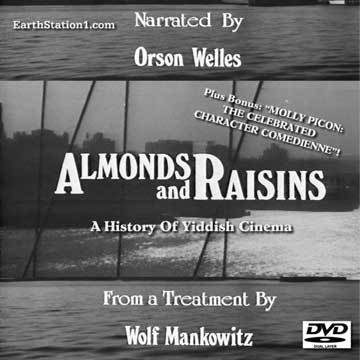
Orson Welles Narrates This Entertaining And Moving Story Of The Yiddish Movie Industry With The Especial Assistance Of Yiddish Theatre And Film Stars Herschel Bernardi, Leo Fuchs, Joseph Green, Miriam Kressyn, Leon Liebgold, David Opatoshu, Molly Picon And Zvee Scooler (Color, 1983, 1 Hour 26 Minutes) PLUS BONUS: MOLLY PICON: THE CELEBRATED CHARACTER COMEDIENNE, One Of The Very First Sound Films Ever Made In Honor Of The Great Yiddish Theatre And Film Talent Molly Picon! (Black/White, 1929, 11 Minutes) -- Another VHS-Era Classic Collection From The Golden Age Of Cable Television, Presented In Our Highest DVD Quality MPEG Video Format At 9.1 MBPS As A MP4 Video Download Or Archival Quality All Regions Format DVD! #Yiddish #YiddishCinema #YiddishMovies #YiddishFilms #AlmondsAndRaisins #RaisinsAndAlmonds #OrsonWelles #Documentaries #HerschelBernardi #LeoFuchs #JosephGreen #MiriamKressyn #LeonLiebgold #DavidOpatoshu #MollyPicon #ZveeScooler #LowerEastSide #LES #Manhattan #NewYorkCity #NYC #Theater #Theatre #Stage #Movies #Film #MotionPictures #Hollywood #AmericanCinema #CinemaOfTheUS #MP4 #VideoDownload #DVD
* July 9, 2026: Updated With MOLLY PICON: THE CELEBRATED CHARACTER COMEDIENNE!
Almonds And Raisins is a documentary examination of the dozens of Yiddish-language talking films made in the United States and Europe between the release of The Jazz Singer in 1927 and the outbreak of the Second World War in 1939. It spans the careers of Yiddish-language performers Herschel Bernardi, Celia Adler, Eugenie Besserer, Fanny Brice, Leo Fuchs, Joseph Green, George Jessel, Al Jolson, Miriam Kressyn, Leon Liebgold, May McAvoy, May McAvoy, David Opatoshu, Moyshe Oysher, Molly Picon, Seymour Rechzeit, Maurice Schwartz, Zvee Scooler and more.
Yiddish Cinema (Yiddish (Romanized): Idish-Shprakhige Kino, Idishe Kino) refers to the Yiddish language film industry which produced some 130 full-length motion pictures and 30 shorts during its heyday from 1911 and 1940. Yiddish film almost disappeared after World War II, due to the Holocaust and the linguistic acculturation of Jewish immigrants, though new pictures are still made sporadically.
Yiddish Theatre consists of plays written and performed primarily by Ashkenazi Jews in the Yiddish language. The range of Yiddish Theatre is broad: operetta, musical comedy, and satiric or nostalgic revues; melodrama; naturalist drama; expressionist and modernist plays. At its height, its geographical scope was comparably broad: from the late 19th century until just before World War II, professional Yiddish Theatre could be found throughout the heavily Jewish areas of Eastern and East Central Europe, but also in Berlin, London, Paris, Buenos Aires and New York City. Yiddish Theatre's roots include the often satiric plays traditionally performed during religious holiday of Purim (known as Purimshpils); the singing of cantors in the synagogues; Jewish secular song and dramatic improvisation; exposure to the theatre traditions of various European countries, and the Jewish literary culture that had grown in the wake of the Jewish enlightenment (Haskalah). Israil Bercovici wrote that it is through Yiddish Theatre that "Jewish culture entered in dialogue with the outside world," both by putting itself on display and by importing theatrical pieces from other cultures. Themes such as immigration, poverty, integration, and strong ancestral ties can be found in many Yiddish Theatre productions.
Molly Picon, Jewish American actress of stage, screen, radio and television, as well as a lyricist and dramatic storyteller, who began her career in Yiddish theatre and film, rising to a star, before transitioning into character roles in English-language productions, most widely known for her role as Yente the Matchmaker in the 1971 musical film Fiddler On The Roof (February 28, 1898 - April 5, 1992) was born Malka Opiekun in New York City to Jewish emigrants Louis (Opiekun) Picon and Clara (Ostrovsky) Picon. Her father was from Warsaw and her mother from near Kyiv. The family began living in Philadelphia, Pennsylvania, when she was three years old. Picon became a star of the Yiddish Theatre District, performing in plays in the District for seven years. Picon was so popular in the 1920s, many shows had her adopted name, Molly, in their title. In 1931, she opened the Molly Picon Theatre. Picon appeared in many films, beginning with silent movies. Her early films were made in Europe; among the first, and earliest to survive, was the Yiddish language East and West, a film adaptation of the 1921 play Mezrach Und Maarev produced in Vienna in 1923. The film depicts a clash of New and Old World Jewish cultures. She plays a US-born daughter who travels with her father back to Galicia in East Central Europe. In 1934, Picon had a musical comedy radio show, The Molly Picon Program, broadcast on WMCA in New York City. In 1938, she starred another radio program on WMCA, I Give You My Life. That program "combined music and dramatic episodes that purported to be the story of her life." Two years later, she starred in Molly Picon's Parade, a variety show on WMCA. Picon made her English language debut on stage in 1940. On Broadway, she starred in the Jerry Herman musical Milk and Honey in 1961. In 1966, she dropped out of the disastrous Chu Chem during previews in Philadelphia; the show closed before it reached Broadway. Picon had a bit part in the 1948 film The Naked City as the woman running a news-stand and soda fountain towards the climax of the film. Her first major Anglophonic role in the movies was in the film version of Come Blow Your Horn (1963), with Frank Sinatra. One of her best-known film roles was as Yente the Matchmaker in The 1971 film adaptation of the Broadway hit Fiddler on the Roof. Picon appeared as Molly Gordon in an episode of CBS's Gomer Pyle, USMC and had a recurring role as Mrs. Bronson in the NBC police comedy Car 54, Where Are You?. In the comedy For Pete's Sake (1974), she appeared as an elderly madam ("Mrs. Cherry") who arranges a disastrous stint for Barbra Streisand on a job as a call girl. She later had television roles as Mother Mishkin in the third episode of Vegas, a role on the soap opera Somerset and appeared in a few episodes of The Facts of Life as Natalie's grandmother. Picon's final role was as Roger Moore's mother in the comedies Cannonball Run and its sequel Cannonball Run II in 1981 and 1984, respectively. Picon wrote So Laugh a Little (1962), a biography about her family. In 1980, she published her autobiography, Molly!. Picon was married to actor and playwright Yankel (Jacob) Kalich from 1919 until his death from cancer in 1975. They had no children. Molly Picon died in Lancaster, Pennsylvania, aged 94. She is buried at Mount Hebron Cemetery in Flushing, Queens, New York City.
New Permanent Price Reductions!
Launching Our Summer "I Never Knew That Existed!" Days!
A New Commitment From EarthStation1.com!
Issued Sunday, June 28, 2026
For thirty years, EarthStation1.com has existed for one purpose: to preserve, curate, and share the history of our world through television, radio, film, and documentary media. During that time, the world has changed dramatically. The cost of nearly everything has risen, and for many people, simply making ends meet has become more difficult than ever. We believe that learning, discovery, and the enjoyment of history should never become luxuries reserved only for those who can afford them.
Beginning today, EarthStation1.com is introducing a new long-term pricing philosophy. Rather than asking, "What is the highest price people will pay?" we are asking a different question: "What is the fairest price that allows the greatest number of people to own, enjoy, and preserve these remarkable programs?" We want students, teachers, veterans, researchers, families, collectors, and lifelong learners everywhere to have access to the extraordinary stories that have shaped our world—without price becoming an unnecessary barrier.
This is more than a sale. It is a commitment to the future of EarthStation1.com and to the people we have proudly served since 1996. Our hope is simple: that by making our catalog more affordable than ever before, we can place more history into more homes, encourage greater understanding of our shared past, and ensure that these important films, broadcasts, and recordings continue to educate and inspire for generations to come. We invite you to explore our collection, rediscover old favorites, uncover new treasures, and join us as we begin this exciting new chapter together.
— Sam Fellowes
Executive Director of Customer Experience
EarthStation1.com

***** BAAAAHH-DAH-DAH-DAAAAAAHHHH!!! *****
HERALD: Hear ye! Hear ye! Let it be proclaimed throughout the Known and Unknown Universe!
By decree of the Curator of EarthStation1.com™, and with the enthusiastic concurrence of the Executive Director of Customer Experience...
Henceforth shall the proclamation read:
15% (Or More!) Daily Specials
...and there was much rejoicing among historians, documentary enthusiasts, collectors, lovers of old television and radio, seekers of the obscure, and all who delight in discovering the treasures of the past without having to mortgage the present.
The fanfare crescendos... banners unfurl... somewhere, Yul Brynner nods approvingly... and Cecil B. DeMille quietly murmurs, "Print it."

Copyright © 1996-2026 J. C. Kaelin, Jr., Proprietor, EarthStation1.com and MediaOutlet.com.
[Our motto and graphic by Sam Fellowes (2026).]